Where to Go Next
Congrats! You have completed the tutorial.
You might have noticed that I did not introduce every single one of Triton VM’s instructions. With the knowledge you’ve gained over the last few lessons, you should be able to understand the behavior of any instruction.
If you would like to give some feedback, feel free to open an issue. I’d appreciate your thoughts!
Tools
If you want to debug a program or just take a look at how it behaves at runtime, check out Triton TUI. It’s essentially a step-debugger for Triton VM, right in your terminal.
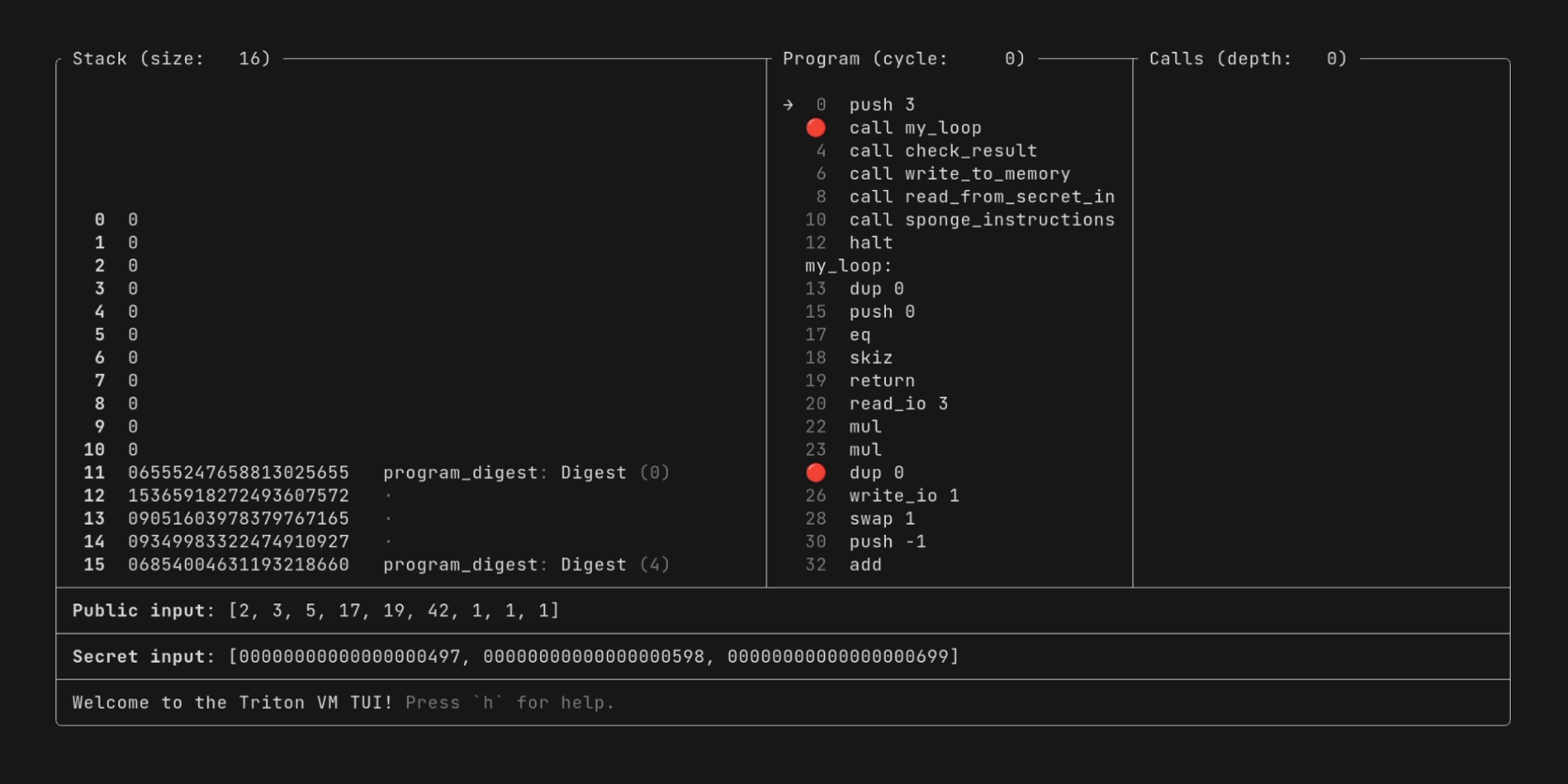
If you want to profile your program, generate proofs for it, or verify such a proof, then take a look at Triton CLI.
If you want to start developing bigger programs, check out tasm-lib, a Rust
library that provides re-usable Triton assembly snippets.
References
When writing Triton assembly, the most important reference is the already-mentioned comprehensive list of instructions.
If you want to take a deeper dive into Triton VM’s inner workings, take a look at the specification. You are now already familiar with many of the concepts, but in the specification, they are explained in greater detail and with a different focus.
Program Ideas
In case you just want to keep programming in Triton assembly, here are some additional program ideas:
- The Fibonacci sequence.
For example, you can write the first
nelements in the Fibonacci sequence to public output. Or you can write a program that only halts if the secret input is thenth element in the Fibonacci sequence. - A triangle verifier. Read three numbers from public input and verify they can be side lengths of a triangle. As a second step, make one side secret and verify that the hidden value from secret input still produces a valid triangle.
- A Sudoku verifier. As a first step, simply verify that a Sudoku from public input follows the rules. In a second step, have only some of the cell entries be public knowledge, and verify that the missing entries as filled from secret input are a valid solution.